
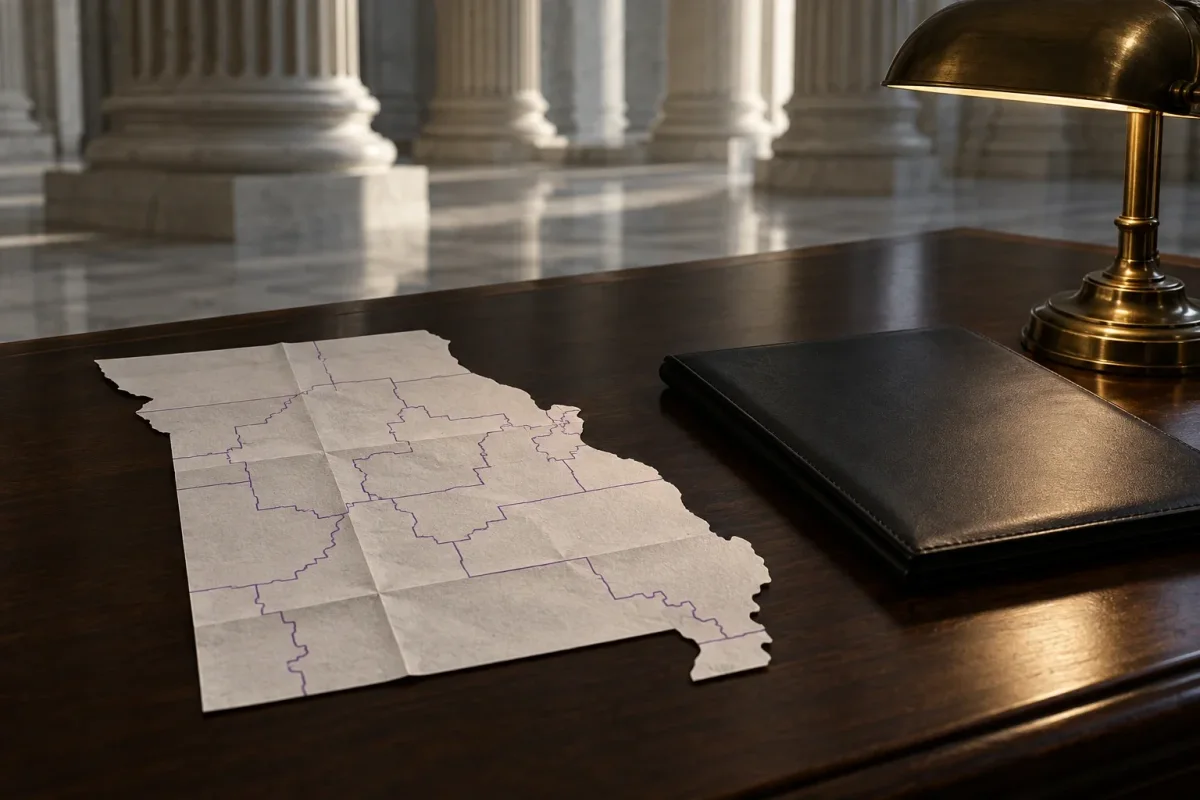
People Not Politicians and Richard von Glahn asked the U.S. Supreme Court on Wednesday to stay a federal judge’s order requiring Missouri to use its new congressional map in the November 2026 elections. Justice Brett Kavanaugh directed Rep. Robert Onder and Missouri Secretary of State Denny Hoskins to respond by 10 a.m. EDT on Thursday.
The filing came one day after Kavanaugh declined Hoskins’ request to disturb a Missouri Supreme Court ruling that barred use of the new map, known as HB 1, unless voters approve it in November. Less than an hour after Kavanaugh acted, Chief U.S. District Judge Stephen Clark issued a temporary restraining order directing the state to use the 2025 map, concluding that challengers in the federal case faced irreparable harm because many voters otherwise would cast general-election ballots for candidates they had no role in nominating.
Missouri redrew its congressional districts last year with encouragement from President Donald Trump, intending to give Republicans seven of the state’s eight U.S. House seats. Opponents submitted more than 300,000 signatures seeking a statewide referendum, but Hoskins rejected the petition on Aug. 4, 2026, arguing that the Missouri Constitution does not authorize referendums on congressional redistricting plans passed by the General Assembly.
In a unanimous Sept. 3 ruling, the Missouri Supreme Court reversed Hoskins. It held that the state constitution authorizes a referendum on “any act of the general assembly” and that no exception applied. Because the petition was legal, sufficient and timely, the court concluded that HB 1 had never taken effect and would not do so unless voters approved it in the November 2026 general election. Hoskins then sought U.S. Supreme Court intervention, raising federal constitutional claims under the elections clause and the right to vote; von Glahn argued that the state-law basis for the ruling barred federal review and that longstanding precedent permits state referendum procedures to constrain congressional redistricting legislation.
After the U.S. Court of Appeals for the 8th Circuit refused to pause Clark’s order, the map’s opponents asked the Supreme Court to intervene. They argued that the federal order conflicts with the authoritative ruling of Missouri’s highest court and creates the confusion and disruption that the Purcell principle forbids close to an election. They also said a stay would allow officials to proceed under the 2022 map and noted that Hoskins had instructed election administrators to implement that map immediately after the state court’s ruling.
A related contempt dispute is also pending. The Missouri Supreme Court ordered Hoskins to explain why he should not be held in contempt for a Sept. 8 email instructing election officials to use the 2025 map, directed von Glahn to respond, and scheduled oral argument for Thursday morning. Hoskins has asked Clark to block that state-court proceeding.