
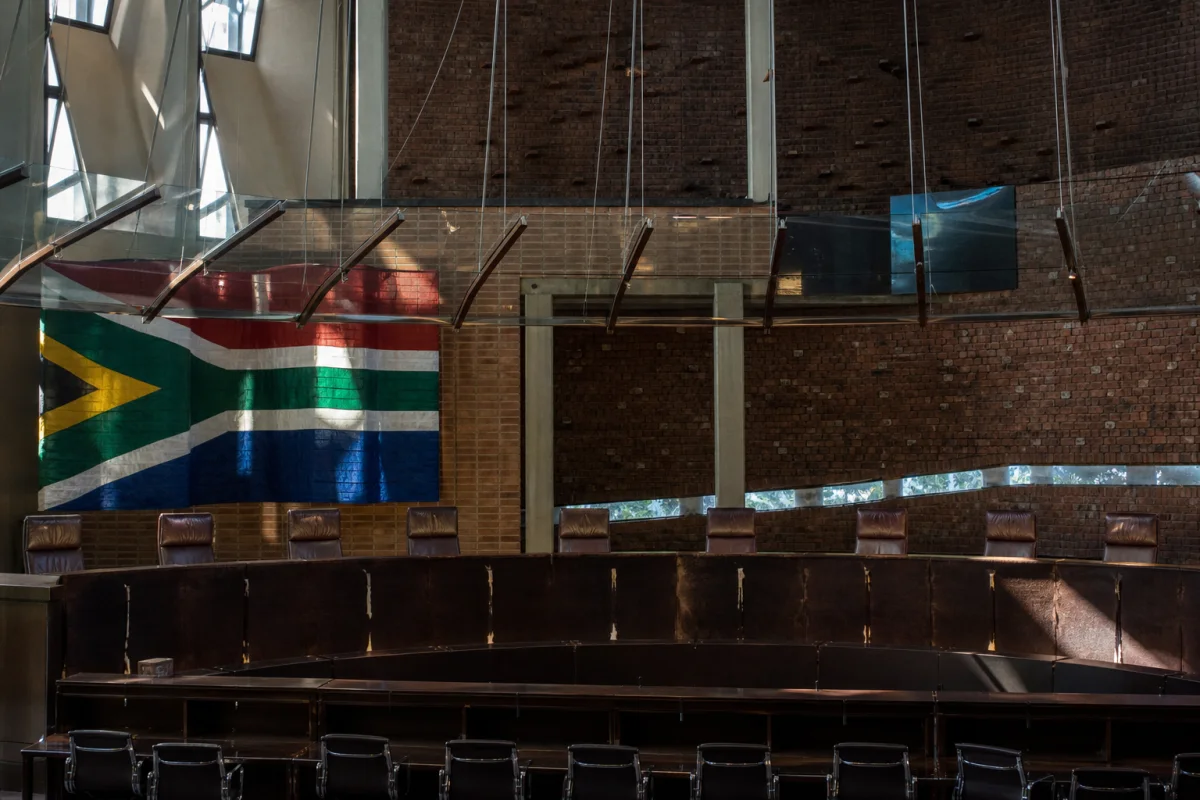
Established in 1994, the Constitutional Court of South Africa held its first official session in February 1995. In an interview with SCOTUSblog, Professor Penelope Andrews described a court that exercises both original and appellate jurisdiction. Section 167 of South Africa’s Constitution identifies it as the country’s highest court and permits it to decide constitutional matters and other matters when it grants leave to appeal on the grounds that they raise “an arguable point of law of general public importance.”
Jurisdiction and institutional design
The court has exclusive authority over disputes between national or provincial organs of state concerning their constitutional status, powers or functions. It may determine the constitutionality of national or provincial legislation, decide that Parliament or the president has failed to meet a constitutional obligation, and certify the constitutionality of a provincial constitution that has overturned an act of Parliament. The court has invalidated acts of Parliament, including the Sexual Offences Act in 1999, the National Prosecuting Authority Amendment Act in 2011, the South African Police Service Amendment Bill in 2011 and, in the year of the interview, the National Health Act.
- The court has 11 justices, including a chief justice and deputy chief justice.
- The Judicial Service Commission manages a public selection process, while the president makes the formal appointment after consultation.
- Judges serve a non-renewable 12-year term or until reaching the mandatory retirement age of 70, whichever comes first.
- Cases are decided by a simple majority, and the chief justice assigns the primary opinion after initial post-hearing deliberations.
The Judicial Service Commission has 23 members drawn from government, the judiciary, the legal profession and civic society, and is presided over by the chief justice. When a vacancy arises, it calls for public nominations and conducts public interviews. It then submits three more names than there are vacancies to the president. The court has a strong tradition of concurrences and dissents, although lengthy separate opinions have become less common in recent years.
Controversial questions and comparisons
The court has addressed corruption and state capture during and after the presidency of Jacob Zuma. In 2021, it ordered that Zuma be imprisoned after finding him guilty of contempt of court. It also upheld or decided cases involving indigenous law, the death penalty, the Truth and Reconciliation Commission, access to health care and anti-retroviral medication, and same-sex marriage. In the 2004 Bhe decision, it held the indigenous practice of primogeniture, which prevented girls and women from inheriting, unconstitutional. The court outlawed the death penalty in 1995.
Andrews said the court is generally viewed as non-partisan, although politicians have attacked judges as “activist” and partisan. She described it as more respected than Parliament or the president, while noting that officials have sometimes disregarded decisions, particularly concerning socio-economic rights. The court has not adopted exceptions such as the political question doctrine, and South Africa’s broad standing rules make access to it greater in many ways than access to the U.S. Supreme Court.
On race, the court has heard two major affirmative-action cases and upheld the programs involved. Andrews contrasted this with the U.S. Supreme Court’s approach, noting that South Africa’s Constitution specifically permits affirmative action. She also identified demographic representation and an explicit commitment to constitutional values as strengths of the South African model, while describing the longer judicial careers of many U.S. justices as an advantage of the American court.