
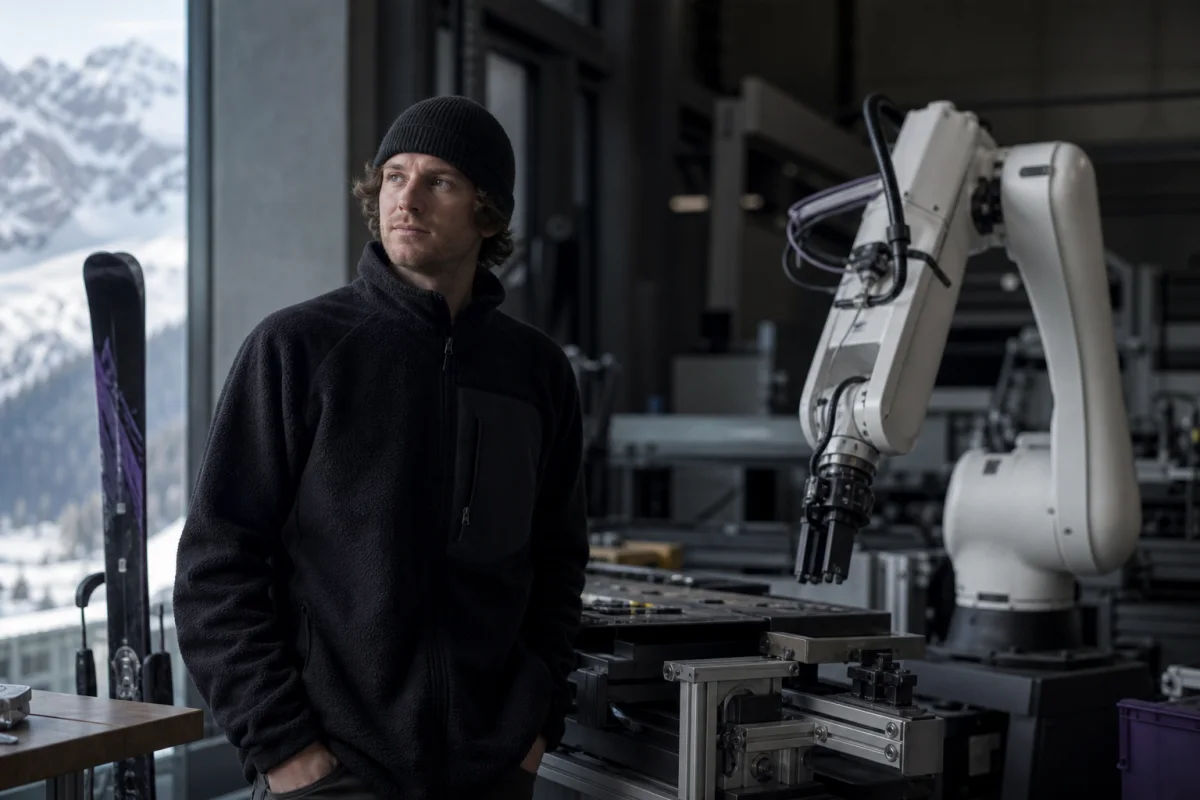
Roman Hölzl’s approach to building RobCo was shaped partly by a life spent competing on skis, where planning, speed and recovery from mistakes were constant demands. By his mid-teens, he was competing against some of Europe’s best skiers, earning sponsorships from two French companies and winning events including King of Shred. In the winter of 2012, shortly before a planned family ski trip to Canada, Hölzl suffered a compression fracture in two places in his lower back. He recovered, but the injury forced him to remain still and reconsider a future that might not include skiing.
The change redirected his competitive focus toward school. After the injury, Hölzl spent weeks wearing a stabilizing exoskeleton and gradually returned to the slopes. He also began dedicating the time he would otherwise have spent skiing to university, moving from the bottom 25% of his class to the top 3%. In 2016, he enrolled at the Technical University of Munich and pursued human factors engineering, with research interests including user experience in robotics and autonomous driving. He later completed a research fellowship at Harvard.
From university lab to factory floor
At the Technical University of Munich, Hölzl met Constantin Dresel and Paul Maroldt while beginning a Ph.D. program in 2019. Together, they ran a practical robotics lab course and explored modular industrial robots that could be nimble, safe and quickly reconfigured. Their aim was to serve smaller manufacturers that historically had not been able to afford automation. The founders launched RobCo in 2020, commercializing work developed in the lab. The company focused on labor shortages and on robots capable of performing repeatable, complex manual tasks.
RobCo’s modular robotic arms are designed for discrete tasks that would ordinarily require a human operator. They are small enough not to require bolting to factory floors and can be operational within a couple of days rather than weeks. Customers pay between 2,000 and 4,000 euros per month, which the article describes as about one-third of the cost of the two shift workers their labor can replicate. About 70% of RobCo’s customers had never used physical automation before. Examples include de Crignis, where RobCo arms mold sheet metal into machine cladding, and Frank Präzisionsteile, where the arms fill overnight shifts.
The company was approaching 100 employees and supplying small- and mid-sized manufacturers in Germany. Hölzl said RobCo’s potential market may include tens of thousands of companies, while the business was also collecting data with the long-term aim of making robots work in more unstructured settings. Sequoia encountered RobCo in 2022 and viewed its premise as “UiPath for the real world.” Luciana Lixandru, who had led UiPath’s Series A, connected the company’s robotics focus with the challenge of scaling physical products: every robot must be built, shipped, installed and monitored. RobCo’s early strategy was to start in Germany, a hub of mid-sized engineering and manufacturing companies, while eventually seeking expansion across the globe.
In Germany we have a quote that means, basically, ‘Impossible is nothing.’